I’ve mentioned a few times recently that DWG have seen and experienced just about everything when it comes to cryptocurrencies. The good, the bad and yes – the ugly. So when I tell investors we’ve been through this before, I really mean it.
I understand why some people feel this time is different. There is so much going on with tariffs, wars, geopolitical tension, and policy shifts but I’m here to let you know, we’ve experienced market events that felt every bit as catastrophic as what we’re experiencing now. And we made it through every single one.
But not only that, the market came out stronger on the other side.
I thought I’d take you on a quick tour through some of the storms we’ve weathered in past crypto cycles. My goal is to show that turbulence isn’t new to crypto – it’s something every groundbreaking technology has faced on its path to maturity.
Let’s dive in.
February 2014 – Mt. Gox collapse
In early 2014, the largest Bitcoin exchange in the world imploded. Around 850,000 BTC had been stolen from Mt. Gox – worth roughly $450 million at the time. Withdrawals were frozen, trust evaporated overnight, and Bitcoin fell more than 30%.
It was absolute chaos.
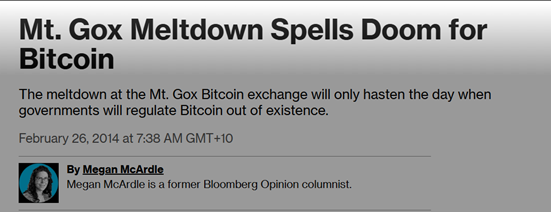
This event exposed just how fragile early exchange infrastructure really was and shattered the belief that centralised platforms were automatically safe. Investor confidence was crushed and anger, despair and panic took over. If the Crypto Fear & Greed Index had existed back then, it would have been in extreme fear – for a very long time!
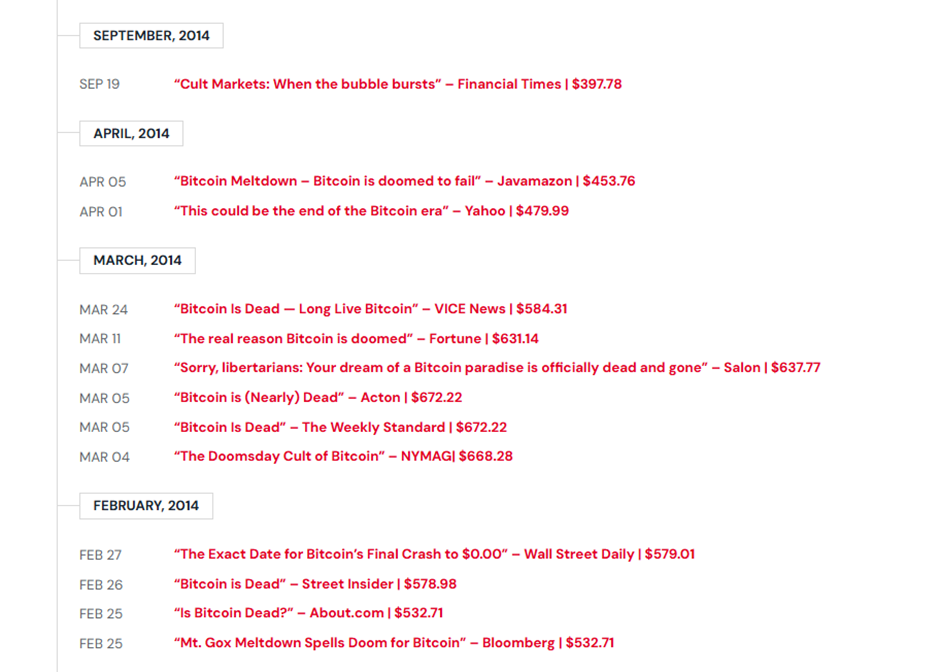
If you scroll back through the Bitcoin obituaries, you’ll see how many bleak headlines we were dealing with.
December 2017 to February 2018 – the crypto winter
In December 2017, Bitcoin peaked near $19,800 before falling to around $3,200.
That’s a drop of roughly 84%.
The ICO bubble burst, regulators cracked down globally, China announced sweeping bans, and a $530 million hack at Coincheck poured fuel on the fire.
More than $800 billion was wiped from the market.
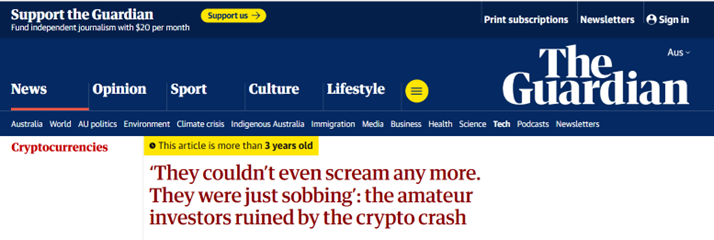
As you can imagine, the headlines were horrible. It was so bad that even long-term Bitcoin holders wondered whether the whole thing had failed for good.
March 2020 – the COVID crash
Remember the early days of covid? We certainly do. We watched Bitcoin’s price take a nosedive from around $8,500 to around $4,000. It dropped more than 50% in 48 hours. Fear dominated the headlines, sentiment collapsed, and miners capitulated. And all of this unfolded while the world was shutting down and the media screamed about a global pandemic.
To say sentiment was dire would be an understatement.
April to June 2021 – China bans mining
When China shut down more than half of the global Bitcoin hash rate almost overnight, Bitcoin plunged from its $64,000 peak in April right down to the low $30,000s by June/July.
Could you imagine waking up and seeing this headline staring back at you?

Many investors genuinely feared the network could become vulnerable to attacks or fail to process transactions reliably. And underneath that was a deeper fear: if a major global power could distrupt mining so quickly, what was stopping other governments from doing the same?
2022 – Terra, LUNA, and FTX
In 2022, we didn’t just deal with one shocking crypto catastrophe, we dealt with two.
First came the collapse of UST and LUNA, where roughly $45 billion in value vanished in days. Then came FTX, which was considered one of the most reputable exchanges in the industry.
FTX revealed an $8 billion hole in its balance sheet. The fallout erased more than $200 billion from the market and froze lending across the ecosystem. Both retail and institutional trust collapsed. The mainstream narrative didn’t just play on investor emotions, it turned openly hostile.

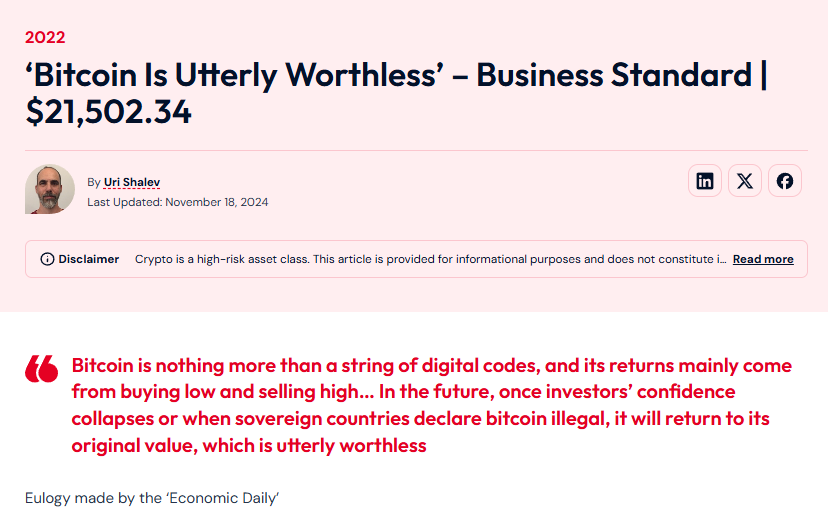
And yet – through each of these so called ‘disasters’, where Bitcoin was declared dead, it found its way back into the limelight every single time.
At DWG, we’ve picked up the pieces of investor confidence time and time again. Many of those same people went on to recover – and do very well.
And none of these events killed crypto.
But here’s the important part. Back then, we only had a fraction of the positive catalysts that we have in 2026. Today, the landscape looks very different.
We have a wave of institutional capital steadily moving into the space.
We have ETFs opening the door for traditional investors at scale.
We have a far more constructive US political environment around crypto.
We’re seeing improving regulatory clarity instead of constant uncertainty.
Tokenisation is moving from theory into real-world execution.
Stablecoins are becoming core financial plumbing, not fringe experiments.
And behind it all, monetary pressure and liquidity are building again.
That’s the difference.
The volatility hasn’t disappeared, but the foundation beneath this cycle is stronger, broader, and more legitimised than any previous time.
Every major cycle has had moments that felt like breaking points. And while history may not repeat exactly, I can tell you that the emotions of each cycle are the same. It’s never easy to sit through it, but history shows that the most uncomfortable periods often lay the groundwork for prosperity in the future.






If you haven’t heard the latest crypto news, the United States Securities and Exchange Commission (SEC) is taking legal action…

So many people believe it’s too late to make money from crypto, and that if you didn’t get in on…

With all the volatility in the market right now, I thought I’d send out this update to let you know…